OpenRouter
Browse the OpenRouter catalogue with per-provider pricing, uptime and latency percentiles, manage API keys and credits, and run speech synthesis and transcription from the Speech tab.
What you can manage
- Models — the full catalogue across every modality, with per-million-token pricing, context length, tokenizer and knowledge cutoff.
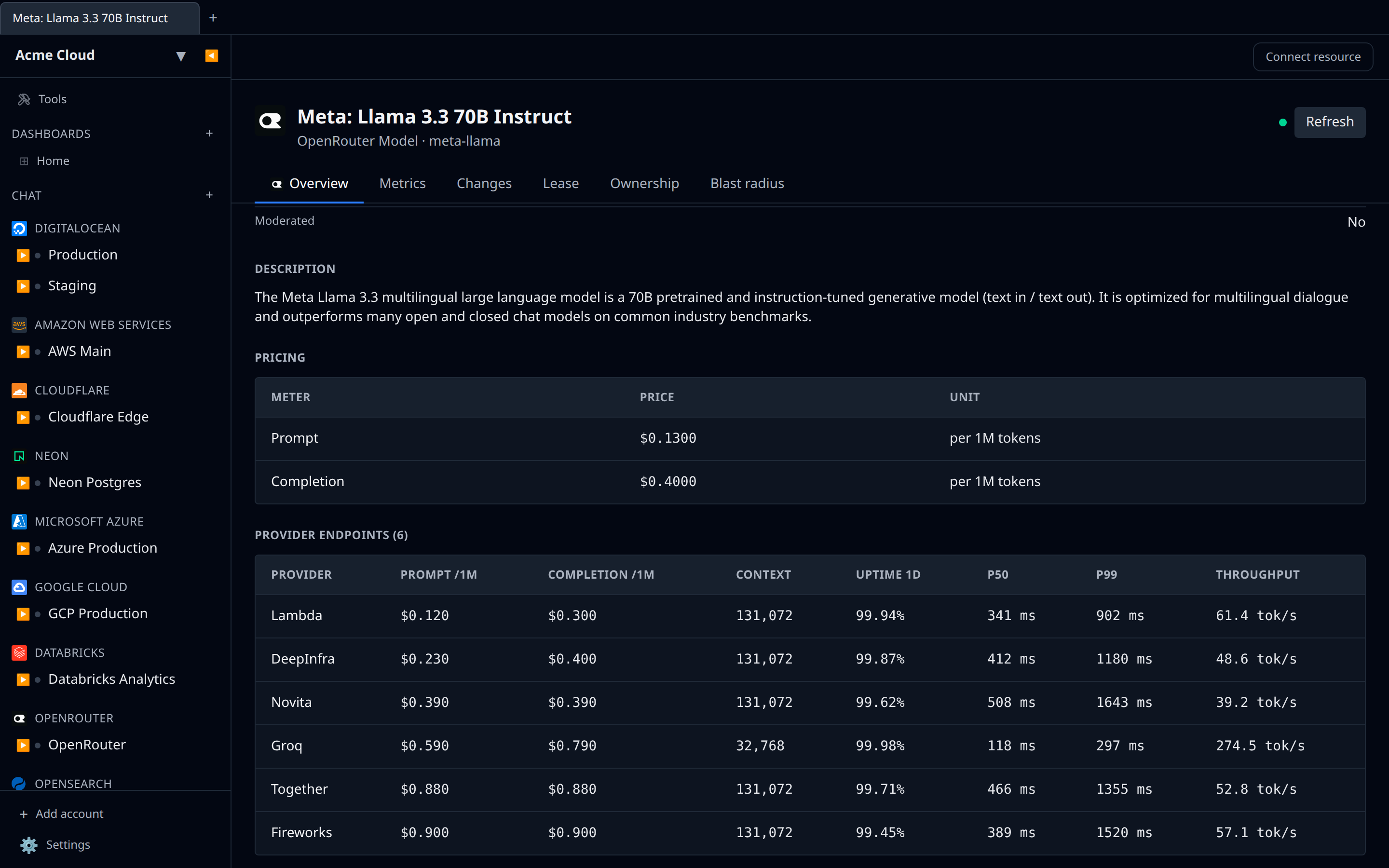
- Model endpoints — the thing that is genuinely unique to OpenRouter: each provider’s own serving endpoint for a model, with its own price, uptime over 5 minutes / 30 minutes / 1 day, latency p50–p99 and throughput. This is how you tell whether “GPT-4 on OpenRouter” is the cheap slow one or the fast expensive one today.
- Providers — every upstream OpenRouter routes to, with headquarters and datacenter regions for data-residency checks.
- API keys — full CRUD, including per-key credit limits, reset interval (daily/weekly/monthly), expiry, and whether BYOK usage counts against the limit.
Credentials
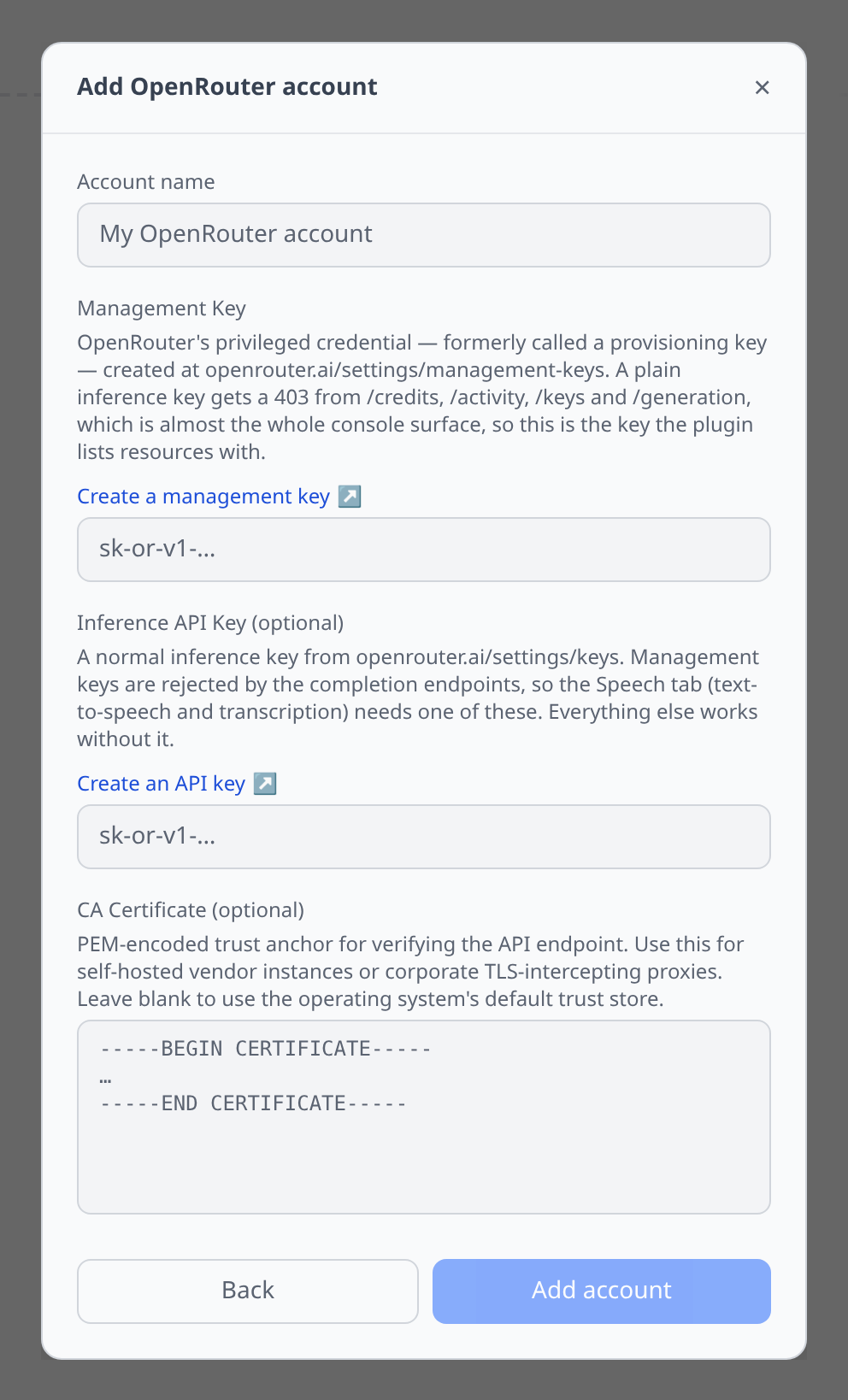
OpenRouter needs two keys, because neither one can do the other’s job.
Management Key (required) — openrouter.ai/settings/management-keys. This is what OpenRouter used to call a provisioning key; the schema still carries both names. It is the only credential /credits, /activity and /keys accept — a plain inference key gets a 403 from all of them, which is very nearly the whole console surface. This is the key the plugin lists resources with.
Inference API Key (optional) — openrouter.ai/settings/keys. A normal sk-or-v1-… key. Management keys are explicitly rejected by the completion endpoints, so the Speech tab needs one of these. Without it every list still works and the Speech tab renders with an explanation instead of failing.
Comparing providers for a model
Open any model and scroll to Provider endpoints. Every provider serving that model is listed with its prompt and completion price per million tokens, context window, 1-day uptime, p50 and p99 latency, and p50 throughput — the whole routing decision on one line each.
The top-level Model Endpoints list is capped to the most popular models, because listing endpoints for the entire catalogue would be one API call per model. A model’s own page always shows all of its endpoints regardless.
The Speech tab
Models that produce speech or transcription get a Speech tab.
- Synthesize posts to
POST /audio/speechand asks for MP3. The model picker is populated live fromGET /models?output_modalities=speech, and the voice picker from each model’s ownsupported_voices— so the voices for the model you are looking at come first, and every entry says which model it belongs to. - Transcribe posts to
POST /audio/transcriptions. The endpoint takes either a multipart upload or a JSON body with base64 audio; the plugin uses the JSON form, because your clip already arrives base64-encoded from the browser and re-encoding it would be pure waste.
Both halves share one model picker. If you leave it on a transcription model and press Synthesize, the plugin quietly falls back to a valid speech model rather than sending a request OpenRouter will reject.
Costs and metrics
Spend comes from GET /activity, broken down by day, model and upstream provider, so the cost page attributes spend to the provider that actually served the request. Each model’s Metrics tab charts its daily spend and request count.
Remaining account credit is read from GET /credits and shown on API key cards.
Tips & limits
/activityonly covers the last 30 completed UTC days. There is no deeper history to backfill, so the cost chart starts 30 days ago and no earlier.- Pagination is
offset+limit, not a cursor. The model list is fetched 1,000 at a time — OpenRouter’s maximum. GET /modelsdefaults to text-only. Image, speech, transcription and embedding models only appear when you ask for every modality, which the plugin does. Dedicated audio models reportspeechandtranscriptionas their output modality, notaudio—audiois reserved for omni chat models.- Prices arrive as decimal strings in USD per token. The app normalizes everything to dollars per million tokens so models are comparable without mental arithmetic.
- Uploads are capped at 25 MB.
- The plaintext of a new API key is shown once.
POST /keysis the only response that ever contains it; OpenRouter cannot return it again. - Mid-stream errors are not HTTP errors. Once a streamed response emits its first token the
200is already committed, so a failure arrives as an SSE event withfinish_reason: "error"rather than a status code. Nothing in this plugin streams, but it is worth knowing if you are debugging your own OpenRouter integration alongside it.