Work in progressThese docs are still being written and are currently mostly AI-generated. Some details may be inaccurate or incomplete.
ClickHouse
Manage ClickHouse Cloud services and query HTTP interface endpoints.
What you can manage
- ClickHouse Cloud services (create with provider / region / replica picker, start / stop)
- HTTP interface SQL editor against any ClickHouse endpoint
Credentials
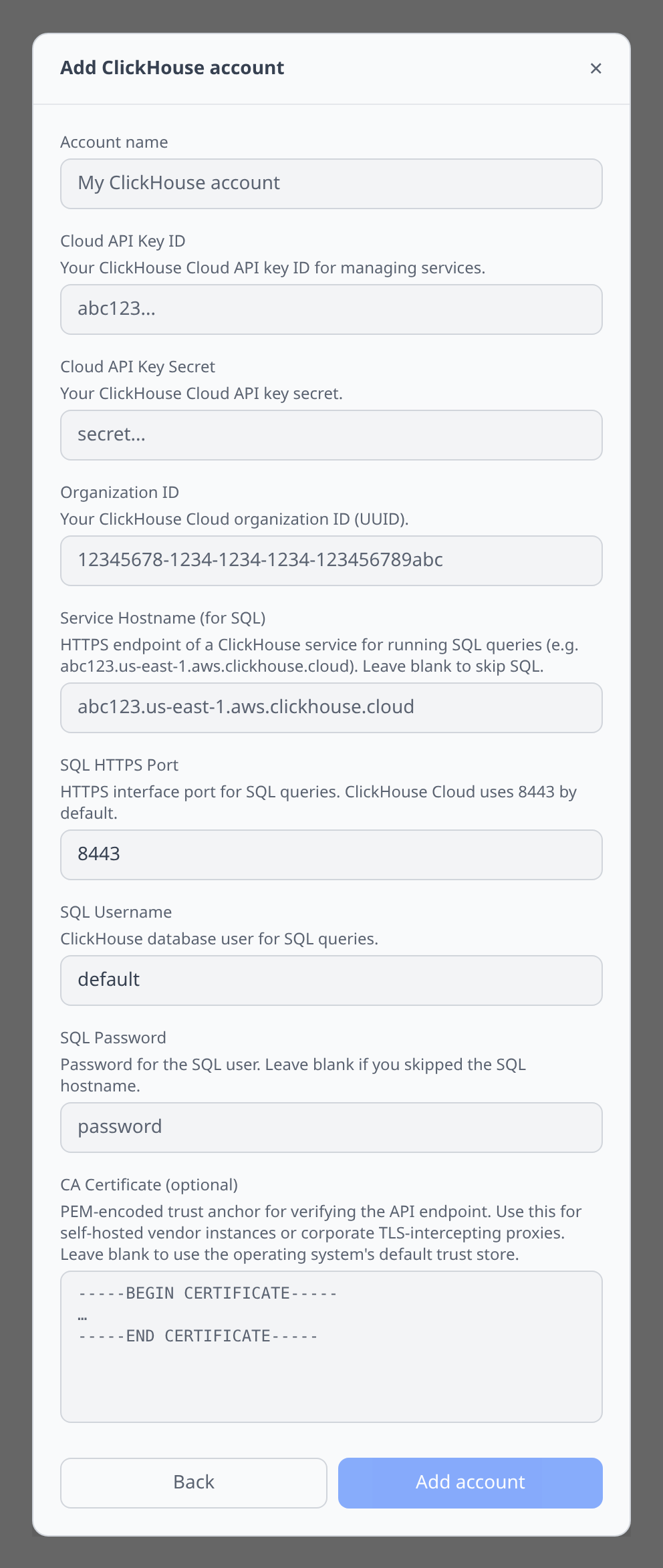
ClickHouse accounts hold two complementary credential sets in a single record — the Cloud API for service management plus a direct connection for SQL queries:
Cloud API (for create / start / stop on ClickHouse Cloud)
- Cloud API Key ID and Cloud API Key Secret — generate at ClickHouse Cloud → API Keys.
- Organization ID — your ClickHouse Cloud organization.
SQL connection (optional — for the SQL editor, works against Cloud or self-hosted)
- Service Hostname (for SQL) — the HTTPS host of the ClickHouse service. Leave blank to skip SQL and use the account for service management only.
- SQL Username and SQL Password.
Notable flows
- SQL editor — streaming results for large queries.
- Service creation on ClickHouse Cloud with provider / region / replica options.
- Secret export is not yet supported for ClickHouse — pull connection strings manually.
Tips & limits
- Very large result sets stream into the grid; expect high memory use on the client for 10M+ row selects. Use
LIMITor export. - Cloud services scale to zero; a first query after idle can take 10–20 seconds to wake.
Cost graphs
ClickHouse Cloud organizations feed cost graphs & budgets via the organization usageCost API — daily costs per service with compute / storage / backup / data-transfer / ClickPipes breakdowns.
- A read-only (Developer role) Cloud API key is sufficient.
- Amounts are ClickHouse Credits at the 1 CHC = $1 list price — negotiated committed-spend discounts are not reflected.