Anthropic
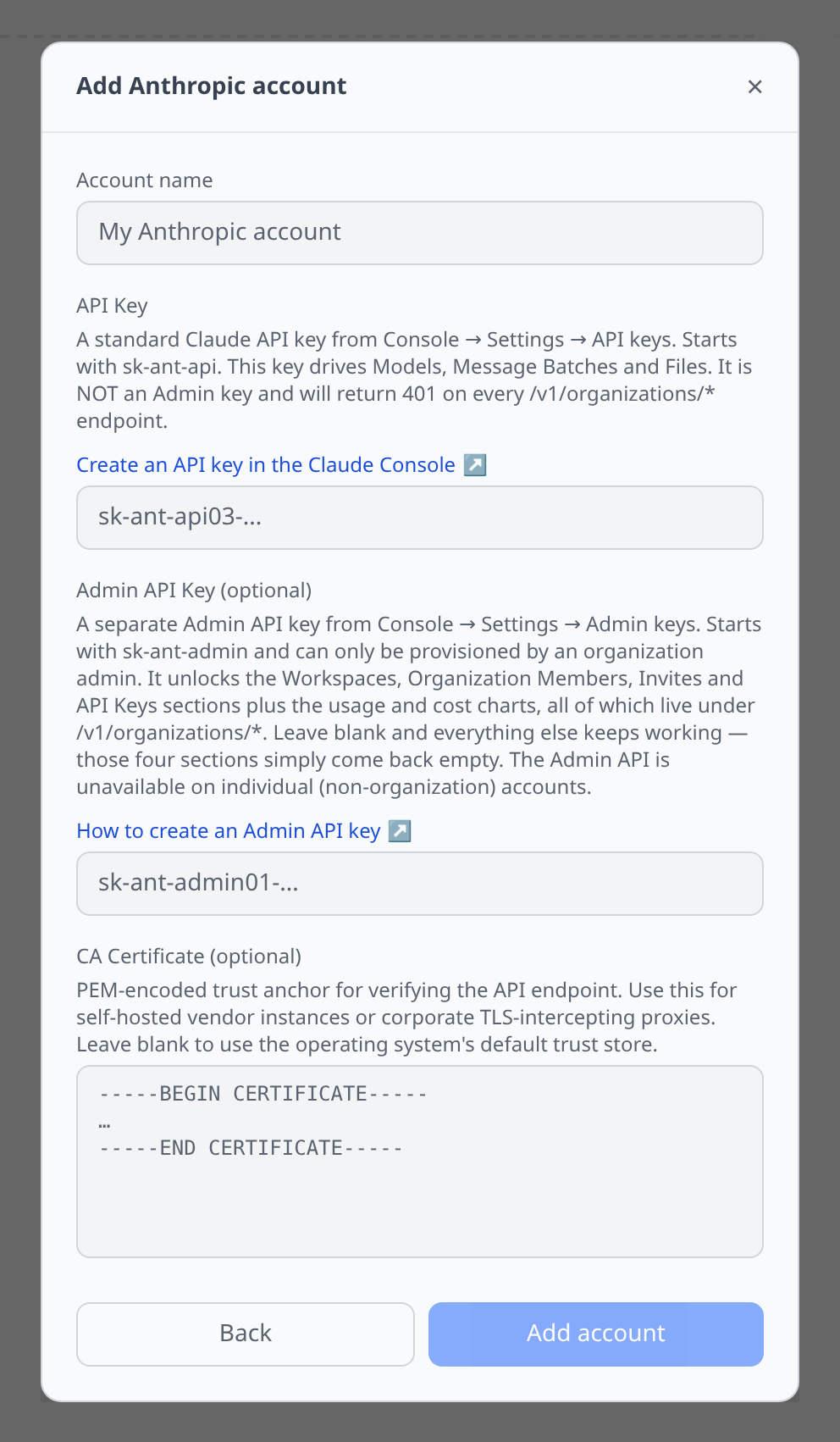
Claude models, Message Batches and Files, plus workspaces, members, invites, API keys, usage and cost reporting with an Admin API key.
What you can manage
- Models — every Claude model this key is entitled to call, with its real context window, output cap, and the full capability matrix: vision, PDF input, batch eligibility, citations, code execution, structured outputs, extended thinking and context management. Read-only, with a usage chart.
- Message Batches — asynchronous batch jobs with their per-status request counters. Cancel one while it is in progress; delete it once processing has ended.
- Files — anything uploaded through the Files API and referenced from a content block by
file_id(delete). - Workspaces — the boundary API keys, files, batches and rate limits are scoped to. Create, rename, and archive. Admin key only.
- Organization members — role changes and removal. Admin key only.
- Invites — send and revoke. Admin key only.
- API keys — listed, renamed, and moved between active, inactive and archived. Never created or deleted. Admin key only.
Credentials
Anthropic splits its API across two credentials that share a prefix but nothing else.
API Key (required) — Console → Settings → API keys. Starts sk-ant-api. This drives Models, Message Batches and Files. It is not an admin key and returns 401 on every /v1/organizations/* endpoint.
Admin API Key (optional) — Console → Settings → Admin keys. Starts sk-ant-admin, and only an organization admin can provision one. It unlocks the Workspaces, Organization Members, Invites and API Keys sections plus the usage and cost charts — all of which live under /v1/organizations/*. Leave it blank and everything else keeps working; those four sections simply come back empty.
The Admin API does not exist on individual (non-organization) accounts, so there is nothing to add on a personal plan.
Costs
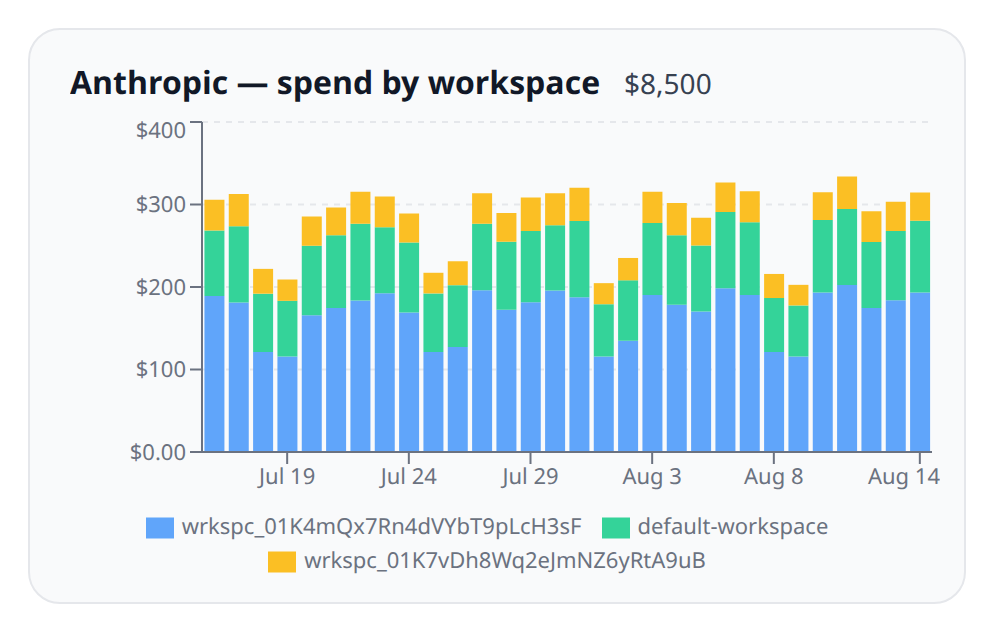
With an admin key attached, spend is collected from GET /v1/organizations/cost_report. That endpoint is daily-granularity only — there is no hourly cost — and can be grouped by description and by workspace, so cost views attribute Claude spend per service and per workspace. Up to a year of history is available, with the last three days re-fetched each sync because Anthropic restates them.
Tips & limits
- There is no speech API. Anthropic ships no text-to-speech or transcription endpoint of any kind, so this plugin has no Speech tab — not an omission, just an absence.
- Archiving a workspace is irreversible and immediately revokes every API key scoped to it. There is no unarchive endpoint; the only way back is a new workspace and new keys. That is why archiving is a confirm-guarded header action rather than an ordinary delete button. Historical usage and cost data survives.
- API keys can be listed and renamed but never created or deleted. New keys can only be minted in the Claude Console, “for security reasons”. Revoking one is modelled as a status change to
inactive, which is what the API actually does. - Batch results come back in arbitrary order. The JSONL at
results_urlis not in submission order — match rows back to requests oncustom_id, never on position. - Batches expire 24 hours after creation and are billed at half the interactive rate. Up to 100,000 requests fit in one.
- Invites expire after 21 days and the expiry cannot be changed. On seat-based plans an invite consumes a seat from the lowest tier with availability and fails with a
400when none is free. - Not every role can be assigned over the API.
admin,membership_admin,ownerandprimary_ownerare Console-only, and members holding them cannot be removed through the API either. The roles you can set areuser,developer,billing,claude_code_userand, on Claude Enterprise,managed. - The Default Workspace has no id and never appears in the workspace list — that is Anthropic’s behaviour, not a missing row.